Edi Rama

Edi Rama, Untitled, 2026, oil stick and felt pen on paper, 43 × 34 × 3 cm // 17 × 13 1/2 × 1 in
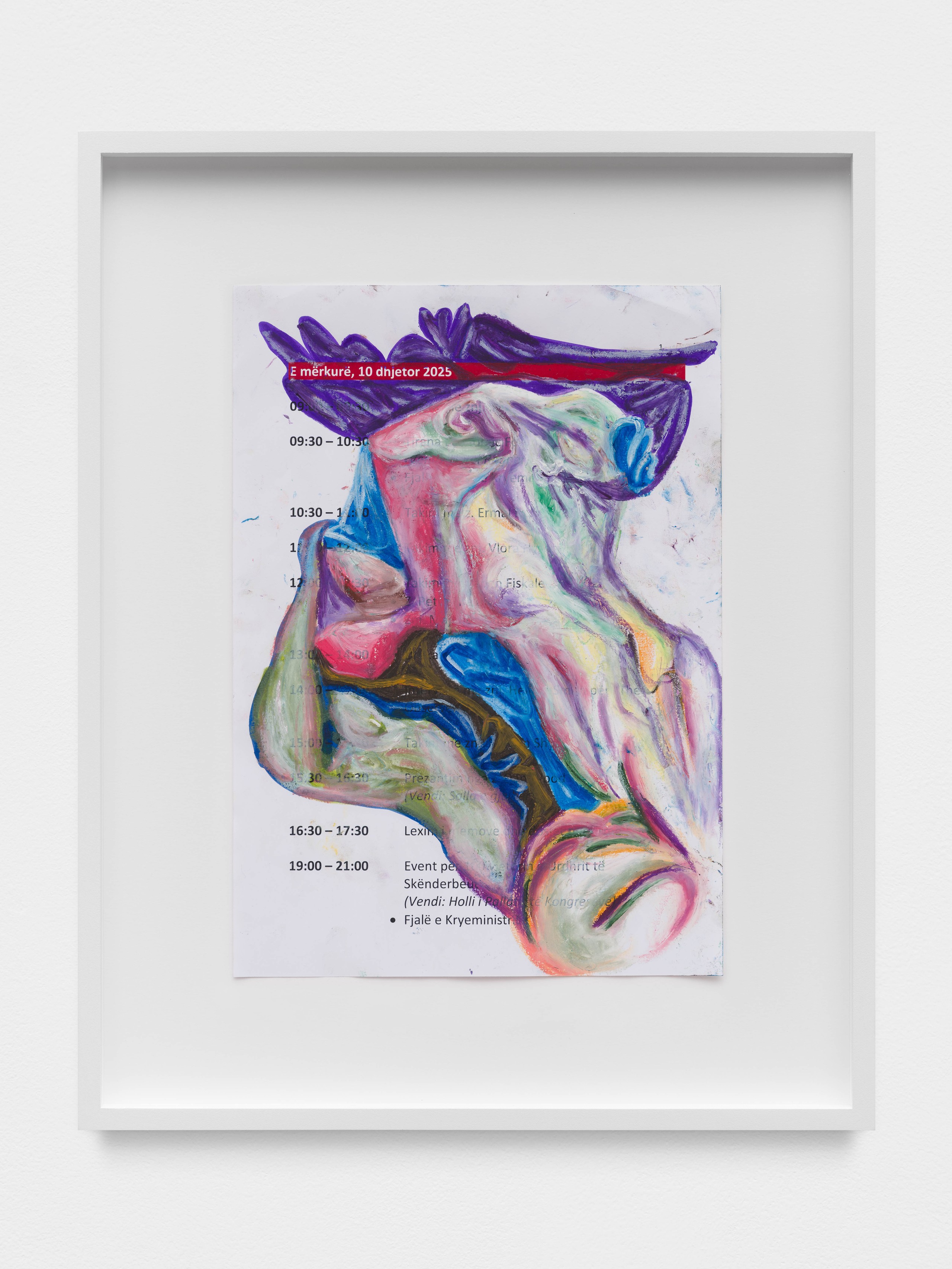
Edi Rama, Untitled, 2026, oil stick and felt pen on paper, 43 × 34 × 3 cm // 17 × 13 1/2 × 1 in

Edi Rama, Untitled, 2026, oil stick and felt pen on paper, 43 × 34 × 3 cm // 17 × 13 1/2 × 1 in
"Politics is the battle of everyday life. And art is like a prayer.” – Edi Rama
Edi Rama trained as a painter at the Academy of Fine Arts in Tirana, where he later taught as a professor. After several years working as an artist in Paris, he returned to Albania in 1998 to serve as Minister of Culture and has been Prime Minister since 2013. During meetings and phone calls, he covers official documents with spontaneous, stream-of-consciousness drawings that merge artistic intuition with political life.
Edi Rama (b. 1964) lives and works in Tirana. He is currently showing his first solo exhibition at Société entitled Chrysalizing. Recent solo exhibitions include Edi Rama at Marian Goodman Gallery, Paris (2024); Improvisations, Zappeion, Athens (2023); WELCOME, Nuno Centeno, Porto (2023); Edi Rama at Alfonso Artiaco, Naples (2020); and Work, which traveled from Kunsthalle Rostock, Germany (2018) to carlier | gebauer, Berlin (2019); and the Nevada Museum of Art, Reno (2019). Earlier presentations of his work include the New Museum, New York (2016); the Venice Biennale (2017, 2003); Tophane-i Amire Culture and Art Center, Istanbul (2015); Musée D’art Contemporain de Montréal (2011); Centre Pompidou, Paris (2010); Haus der Kunst, Munich (2004); and the São Paulo Biennial (1994).
Chrysalizing
Société, Berlin, 2026

Edi Rama, Untitled, 2026, bronze, 34 × 38 × 62 cm // 13 1/2 × 15 × 24 1/2 in
Société is pleased to announce Chrysalizing, Edi Rama‘s first solo exhibition with the gallery, presenting new bronze sculptures. The exhibition‘s title conjures a suspended, generative moment of transformation. This sense of movement resonates across Rama‘s practice: in the passage from drawing to sculpture, in the biomorphic forms his new works assume, and in the broader arc of a life lived at the threshold between artistic and political identity.
Trained as a painter at the Academy of Fine Arts in Tirana, where he subsequently taught as a professor, Rama has pursued an artistic practice in parallel with a political career spanning nearly three decades—first as Minister of Culture, then as Mayor of Tirana from 2000 to 2011, and as Prime Minister since 2013. These two spheres of activity have always informed each other: as mayor, Rama transformed Tirana‘s crumbling communist-era buildings through an ambitious program of colorful geometric facades, demonstrating at the scale of a city that the aesthetic and the political could be one and the same act. It was through this process that his drawing practice first emerged: printing the facades on A4 sheets, he began experimenting with felt tip markers to determine which colors the buildings would be painted—a process that eventually evolved into the vivid stream-of-consciousness drawings made as Prime Minister during meetings at the Kryeministria, Albania‘s seat of government.
These mindscapes act as a springboard for experimentation: organic blots and amorphous shapes evolve into compositions that resist fixed reference or narrative. Rama‘s drawings belong to a lineage of mark-making in which the suspension of conscious control is understood as access to a different order of thinking.
For Chrysalizing, Rama presents a series of new bronze sculptures. Spanning the first floor of the gallery and extending outdoors into the garden, forms on pedestals and low plinths surge, swell, swirl, and multiply. Where earlier ceramic works evoked tactile accumulations of ribbony architectural shapes, these come closer to primordial states of mutation—vegetal, fantastical, creaturely, belonging to no known taxonomy, as if surfacing from some deeper stratum of the subconscious.


Rama created the works by translating his drawings into 3D-printed forms, which he then modeled by hand before casting in bronze. This chain of translations—from drawn line to digital model, back through the artist‘s hands, and finally into a material historically bound to commemoration and the official consecration of power—carries the residue of unguarded mark-making into a form associated with permanence and public authority.
Rama‘s first outdoor sculpture rises over two meters. Undulating forms at the base push upward to splinter into a proliferation of organic growths—a branching, generative structure that evokes networks of interrelation and emergent connection, extending the traces of private invention into shared spatial experience. A related large-scale bronze will be presented outdoors on the Rhine near Clarastrasse as part of Art Basel Parcours in June 2026.
On the occasion of the Gallery Weekend Berlin Art Talks program, Edi Rama will be joined by artist Anri Sala for a public conversation titled On Intuition, Memory, and Becoming, moderated by the political scientist and art critic Natalia Gierowska on Saturday, May 2 at 3:30 pm at the Neue Nationalgalerie.


Edi Rama, Untitled, 2025, oil stick and felt pen on paper, 43 × 34 × 3 cm // 17 × 13 1/2 × 1 in

Edi Rama, Untitled, 2025, oil stick on paper, 43 × 34 × 3 cm // 17 × 13 1/2 × 1 in

Edi Rama, Untitled, 2025, glazed ceramic, bronze, coated wood, 42 × 45 × 37 cm // 16 1/2 × 17 1/2 × 14 1/2 in

Edi Rama, Untitled, 2025, glazed ceramic, bronze, coated wood, 33 × 72 × 52 cm // 13 × 28 1/2 × 20 1/2 in

Anri Sala on His Mentor, Edi Rama
The artist celebrates an influential statesman and painter whose work constantly crosses the boundaries of art, politics, writing and architecture
By Anri Sala and Marko Gluhaich
I met Edi Rama when I was about ten years old, through our parents. He was a student at the Academy of Arts in Tirana and a decade older than me. My interest in painting was perhaps deeper than was typical for a child, and this caught his attention. I began painting alongside Edi using his oil paints. At that time, under Albania’s communist regime, oil colours were distributed in limited rations exclusively to art students and those officially recognized as artists. Having Edi’s attention and working with a type of paint not usually available to me, I felt like I was entering an unconventional, grown-up, even slightly transgressive world.
What made Edi’s mentorship particularly meaningful was the shared sense of equality, inquisitiveness and wonder, despite my youth and our age difference; this laid the foundation for a unique and long-lasting friendship. From his presence and these encounters, I learned how to observe, filter and internalize, embracing the process of art-making itself rather than fixating solely on the final product. Back then, when all forms of artistic expression were carefully monitored, a painting could only reveal the visible tip of an iceberg; the prospect of bringing something invisible into existence and endowing it with presence, form and tangible reality was simply not conceivable.
Click here to read the full article, published in FRIEZE issue 254
Edi Rama
Marian Goodman, Paris, 2024


Edi Rama, Untitled, 2025, oil stick on paper, 43 × 34 × 3 cm // 17 × 13 1/2 × 1 in

Edi Rama, Untitled, 2025, oil stick and felt pen on paper, 43 × 34 × 3 cm // 17 × 13 1/2 × 1 in
WORK
carlier | gebauer, Berlin, 2019


New Views of Familiar Terrain
Edi Rama's Art
By Hans-Ulrich Obrist
Edi Rama’s art is his politics, and his politics is his art. The Albanian artist—Prime Minister of Albania since 2013 and mayor of Tirana from 2000 to 2011—has produced an artistic language to generate a democratic platform for discussion and exchange. The artist as political activist intervening in societal structures calls to mind Joseph Beuys, whose “social sculpture” transformed artistic practice into political practice, so that everyone could be an artist. Rama, who trained as a painter, might be thought of as linked with Beuys’s legacy in showing the social impact of art within his political practice.
Yet it would be wrong to characterize Rama as simply a political artist; he is also a politician who uses his artistic sensibility in his politics. Over the last few years, new dimensions have expanded his oeuvre. In Edi Rama: WORK at carlier|gebauer, Berlin (January 26–March 9, 2019), Rama presents wallpaper as intervention throughout the gallery space. Made up of a version of his doodles, the wallpaper alters how the drawings within it would conventionally be read; various and serialized, they are an archival mural of the artist’s inner life. Rama described the presentation as a dreamlike experience: a dream of his office “where politics, with its people and its struggles, have evaporated, and what remains within the painted walls are these volumes, like a kind of archaeological record of what life in the office once was: a transformation of the prime-ministerial office wallpaper into a prime-ministerial gallery.” The wallpaper could thus be seen as an archive—a protest against forgetting.
The drawings that make up the wallpaper become a work produced at work, directly informed by the thoughts passing through Rama’s mind while in his office, creating his art at his work, and in the process marrying politics and art in an unprecedented way. Moreover, the drawings reflect a kind of inner movement of the politician in his daily routine, based on simple printed daily diary sheets that note his appointments. Invasive, the drawings dwell on the sheets, rarely adhering to the computer-generated writing and structure of the pages. The natural evolution of the drawn lines contrasts with the underlying typography and structures; they are not symbiotic. The drawings seem to devour daily business, not only because they are non-figurative, but also because of their mode of apparently mindless doodling and ongoing development. The drawings recall Surrealism’s automatic writing and cadavre exquis—the end is at the beginning yet unknown.
We thus enter Rama’s state office on several levels simultaneously. We get to pick his brains through his drawings done at work, while being surrounded by what he sees when he makes the work. In a way we see through Rama’s eyes, learning through his hands. Yet we are left free to imagine our own beginning and end of the experience presented. Rama describes the drawings as less of an active creation than an automated tool that his hands make use of in order to help him focus. As his long-term friend and collaborator artist Anri Sala puts it: “What do we see when we are put in Rama’s seat of automatic creation? That in fact his drawing is the opposite of absent-mindedness—it is the embodiment of present-mindedness.”

Edi Rama, Untitled, 2025, oil stick and felt pen on paper, 43 × 34 × 3 cm // 17 × 13 1/2 × 1 in

Edi Rama, Untitled, 2025, oil stick and felt pen on paper, 43 × 34 × 3 cm // 17 × 13 1/2 × 1 in
The close connection to artists like Sala comes as no surprise. The two have been friends since Sala’s childhood, and Rama became a guiding figure in Sala’s artistic development and education. Sala and Rama are not only connected by their many conversations about their hometown of Tirana and social effects on art and architecture, but also through their work in Sala’s projects that are based on Rama’s political actions. The engagement with these projects is something like a tool to “comprehend” the actions of Rama as a politician and “rethinking democracy,” as Sala mentioned in an interview with me. The intention of one well-known project was to change the quality of life in the city of Tirana. Having few funds to change the city, Rama decided to change its outward appearance, painting house façades in various colors and patterns. “It is about the utility art can have,” according to Sala. Rama says his actions are not so much about artistic interaction in a society, rather “the interventions in the buildings … were not aesthetic interventions, but an attempt to reopen a path of communication between the individual citizen, the environment and the authorities. … Entering into a process of transformation … means, first of all, trying to give a sense of community by making signs. To a certain extent, I would say that these colors are like fires trying to tell people not to leave.”
One of Sala’s projects referring to Rama’s work is Dammi i Colori (Give Me the Colors; 2003), a video—part documentary and part artwork—in which we hear Rama explain that “the ambition to make this city a city of choice and not of destiny is a utopia in itself.” The video shows Tirana in the various stages of having its façades painted. I have had the privilege of working with Rama on several occasions, notably on the exhibition Utopia Station in 2003, which also showed Rama’s unique ability to use his artistic sensibility to enable a concrete utopia in political activism. The results of his interventions speak for themselves: their impact reaches far beyond mere beautification, even if transformation through beauty emerges as a central theme in Rama’s work. Beauty becomes a tool to unify people in the consideration and treatment of the spaces they encounter, a proposition to elicit new perspectives on familiar territory.
To come back to the Berlin exhibition already mentioned, aptly named WORK, it is interesting to further observe how the sculptures shown here under the same name differ in production and output. For Rama, who would usually create/draw while in his office, the ceramic pieces present an addendum to the rest of his practice, created on days off and holidays. They thus represent a reversion to more conventional studio practice and trigger contemplation of the different forms of making, the different forms of WORK.
These new sculptural works shown in the gallery, “3-D drawings,” as he refers to them also, speak of the playfulness in Rama’s work—the ability to create beauty and mindfulness while allowing experimentation to unfold. The sculptures further point us towards an intimate insight into the artist’s mind, as they become the three-dimensional manifestation of Rama’s thinking processes. As Zaha Hadid told me in our last conversation: “there should be no end to experimentation.”
Published in Edi Rama, WORK, 2019 (Hatje Cantz)
Viva Arte Viva
curated by Christine Macel
Venice Biennale, 2017

In a world full of conflicts and jolts, in which humanism is being seriously jeopardized, art is the most precious part of the human being. It is the ideal place for reflection, individual expression, freedom and fundamental questions. It is a “yes” to life, although sometimes a “but” lies behind. More than ever, the role, the voice and the responsibility of the artist are crucial in the framework of contemporary debates.
Viva Arte Viva is also an exclamation, an expression of the passion for art and for the state of the artist. Viva Arte Viva is a Biennale designed with the artists, by the artists and for the artists. It deals with the forms they propose, the questions they pose, the practices they develop and the forms of life they choose.
Excerpt from the official press release of the 57th Venice Biennale


Edi Rama, Untitled, 2025, oil stick and felt pen on paper, 43 × 34 × 3 cm // 17 × 13 1/2 × 1 in
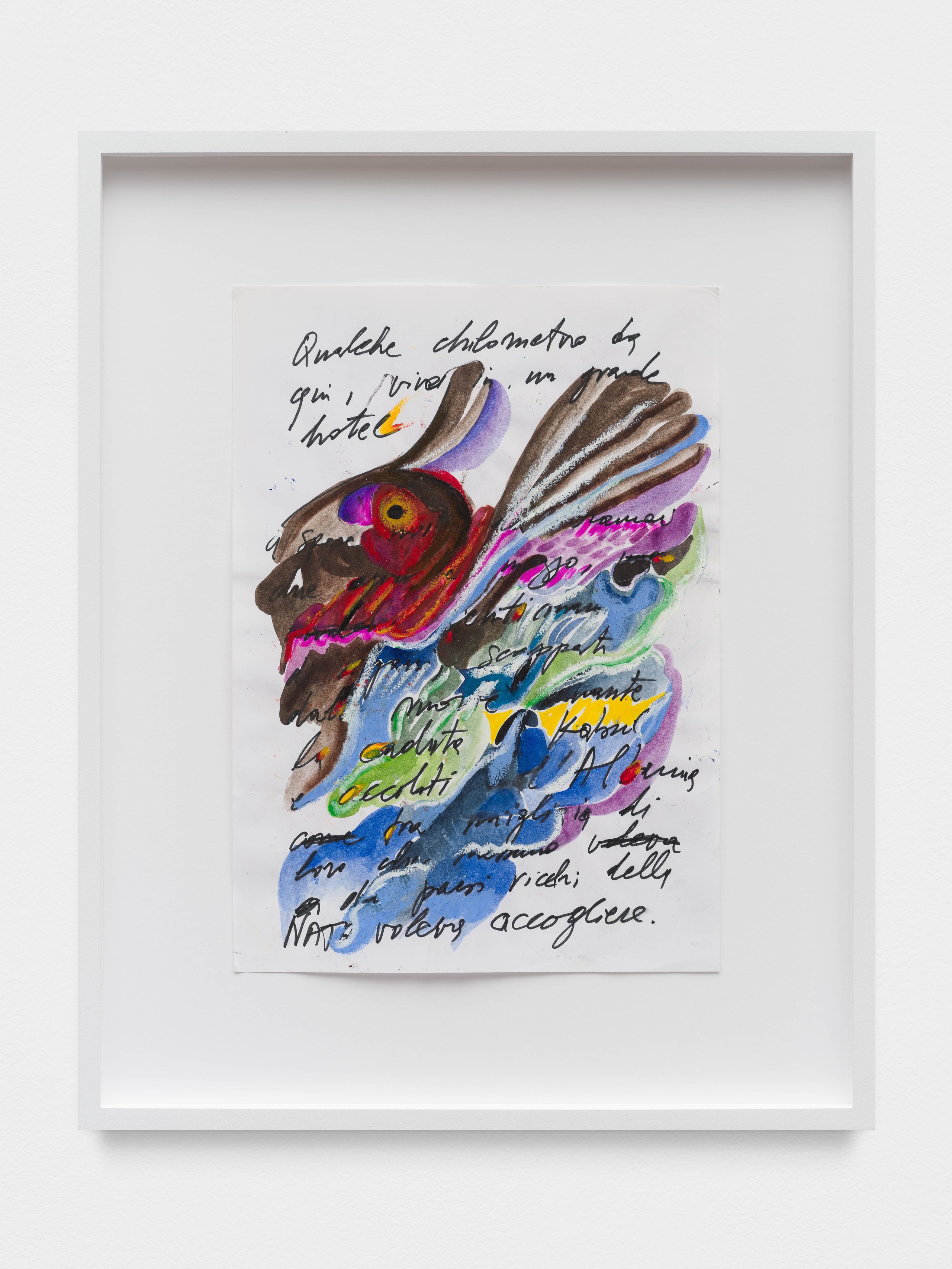
Edi Rama, Untitled, 2025, oil stick, watercolour and felt pen on paper, 43 × 34 × 3 cm // 17 × 13 1/2 × 1 in

Meet Edi Rama, Albania's artist prime minister
The infrastructure’s basic, corruption endemic, but the most powerful man in the country still finds time to doodle in his ministerial diary – and has a show at one of the world’s leading galleries
By Jason Farago
You could debate which country has the most ornate government office: the gilded Elysée, the fortresslike Kremlin, the hulking Great Hall of the People in Beijing. But no leader has an office quite like Edi Rama, the prime minister of Albania. Covering the walls of his office in Tirana are hundreds of drawings: colourful, tightly wound abstractions, with tendrils of colour spiralling out from densely packed cores. The wallpaper, it turns out, is of the prime minister’s own design. “If art cannot make politics more sane,” Rama tells me when we meet one warm Tirana night, “politics, with its insanity, can sometimes make art even better.”
Rama is that rarest thing: not a politician with artistic leanings, but a real, bona fide artist in power. A former art professor, he had no intention to enter public life – and when he did, he didn’t fully abandon his initial career. Now, amid debates on EU accession and occasional squabbles with Balkan neighbours, Rama is preparing for his first US exhibition, at Marian Goodman gallery in New York. It is surely the first time a sitting head of government has nabbed a show at one of the world’s leading galleries; even George W Bush, who started painting only after his presidency, couldn’t get a show outside his own library in Dallas.
Click here to read the full article, published in The Guardian on November 15, 2016
Edi Rama
Solo exhibitions
-
2026
Chrysalizing, Société, Berlin (forthcoming)
-
2024
Edi Rama, Marian Goodman Gallery, Paris
-
2023
Improvisations, Zappeion Megaron, Athens
-
2020
Lavoro, Galleria Alfonso Artiaco, Naples
-
2019
WORK, Nevada Museum of Contemporary Art, Reno
Edi Rama, carlier | gebauer, Berlin
-
2018
Edi Rama, Kunsthalle Rostock, Rostock
-
2017
Edi Rama, Eduardo Secci, Florence
-
2016
Edi Rama, Marian Goodman Gallery, New York
Edi Rama, Alfonso Artiaco, Naples, curated by Lorenza Baroncelli
-
2015
Edi-Tions, Tophane-I Amire Culture and Art Center, Istanbul
Calendar Blossoms, Academy Jao Tsung, Hong Kong
Calendar Flowers, China Institute of Culture, Hong Kong
Daily Drawings, Galerie Kampl, Munich
Les Fleurs du Calendrier, Galerie Micheal Schultz, Berlin
-
1999
Edi Rama, Gallery XXI, Albania
-
1997
Edi Rama, Zilinsko Dailes Galerija, Vilnius
Edi Rama, Palais Jalta, Frankfurt
-
1996
Edi Rama, Galerie Guy Crete, Paris
Edi Rama, Cite Internationale des Arts, Paris
-
1995
Edi Rama, Tour de Pourgnon / Place de la Mediatheque, Die
-
1994
Edi Rama, Gallerie Te&Gi, Tirana
Edi Rama, Palais Jalta, Frankfurt
-
1993
Edi Rama, Acud, Berlin
Edi Rama, Foyles Art Gallery, London
Edi Rama, Janos Gat Gallery, New York
-
1992
Edi Rama, National Art Gallery of Albania, Tirana
-
1991
Edi Rama, Jugendkulturzentrum, Bern
Edi Rama, National Art Gallery of Albania, Tirana
Group exhibitions
-
2026
Dimaches sans fin, Centre Pompidou-Metz, Metz
-
2019
On Display IV, Philara, Düsseldorf
-
2017
Viva Arte Viva, 57th Venice Biennale, Venice
-
2016
Answer Me, installation with Anri Sala, The New Museum, New York
Die Spielchen des Freund Hein, Palastgalerie, Berlin, curated by Gerhard Charles Rump
Not und Spiele, Haus am Lützowplatz, Berlin
-
2015
Biennale of Marrakesh, Marrakesh
-
2014
Tell me Nothing from the Horse, Galerie Michael Schultz, Berlin
Papiers de Bureau, Galerie Rhinocéros & Cie, Paris
-
2013
Creating Space Where There Appears to Be None, Galerie Rüdiger Schöttle, Munich
-
2010
Les Promesses du passé, Centre Pompidou, Paris, curated by Christine Macel
Creating space where there appears to be none – Inversion part II with Anri Sala, About Change Studio, Berlin
-
2004
Utopia Station: auf dem Weg nach Porto Alegre, Haus der Kunst München, Munich
-
2003
50th International Art Exhibition Venice Biennial, Venice
-
1999
48th International Art Exhibition Venice Biennial, Venice
-
1997
Cetinjski Bijenale, Cetinje
-
1996
Balkan Art 96, Novisad
Multilingual Landscape, Centre de l’Art Moderne, Vilnius
Festival d’Automne, Galerie Nikki Diana Marquardt, Paris
-
1995
Biennale de Malte, Malta
-
1994
Galerie Epoches, Athens, Greece
Project for Europe, Nikki Diana Marquardt, Copenhagen
Art, Resistance and the English Garden, Galerie Nikki Diana Marquardt, Paris / Sarajevo
2nd Biennale de Sao Paulo, Sao Paulo
-
1993
Janos Gat Gallery, New York
Stadtmuseum, Graz
Galleria Meeting, Venice
Europaer, Grazer Kunstverein, Graz
-
1992
Schroeder Galerie, Augsburg
Centre International de la Culture, Tirana