Antonio Calderara
In collaboration with Larkin Erdmann
March 13 – April 18, 2026


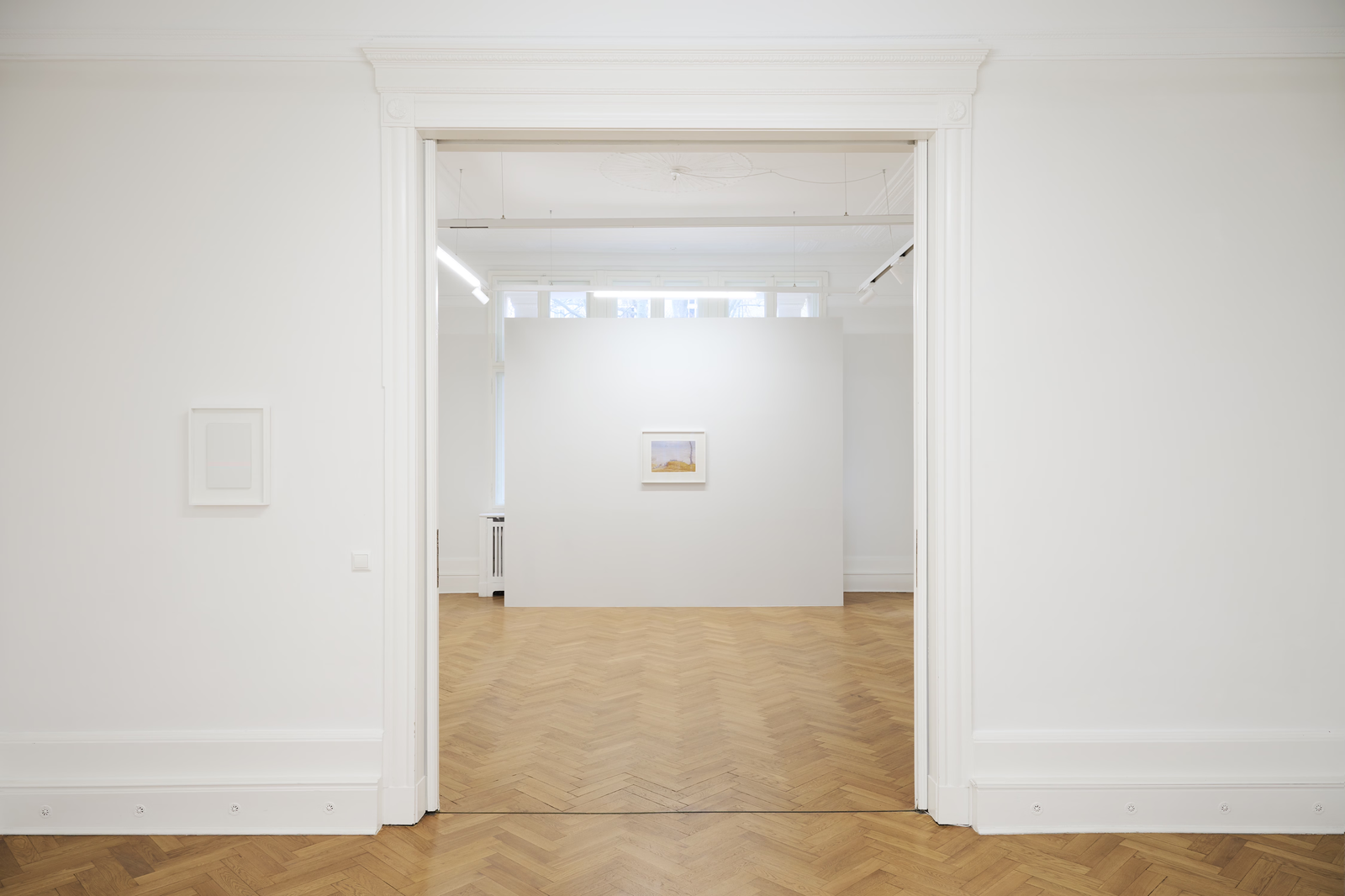
Société and Larkin Erdmann are pleased to announce a joint exhibition dedicated to the work of Antonio Calderara. Antonio Calderara is regarded as one of the quiet yet significant figures of European postwar abstraction. He was born in 1903 in Abbiategrasso near Milan and spent most of his life in Vacciago on Lake Orta. The landscape of this place, with its calm waters, shifting light, and the clear horizon line of the lake, profoundly shaped his artistic perception and remained a central point of reference throughout his work for decades.
Calderara was largely self-taught. His early works from the 1930s and 1940s still relate to the visible world and depict motifs from his immediate surroundings, including houses, churches, and quiet village scenes. Even in these paintings, a clear and reduced pictorial conception becomes evident, in which composition, proportion, and the relationship between light and space play a central role. The serene atmosphere of these early works already hints at the sensitivity for balance and harmony that would later become a defining characteristic of his abstract painting.
In the 1950s Calderara underwent a decisive artistic development. The forms in his paintings became increasingly simplified, while the color palette grew more subtle and restrained. Figurative motifs gradually dissolved, giving way to a more abstract pictorial order. This transformation did not occur abruptly but evolved gradually through his intensive engagement with space, light, and proportion. By the early 1960s Calderara arrived at the distinctive visual language for which he is best known today. Delicate color fields, fine lines, and precise geometric structures define his rigorously composed yet poetic works. Color appears not as an expressive gesture but as a finely calibrated nuance that lends the pictorial space a quiet, almost immaterial presence. The compositions are reduced yet imbued with great sensitivity.
Horizontal and vertical lines structure many of his works and subtly recall the landscape of Lake Orta, whose tranquil expanses and atmospheric light continue to resonate in abstracted form. Calderara’s painting unfolds its effect not through drama, but through balance, precision, and concentration. Within this reduced visual vocabulary, he developed a pictorial world of remarkable calm and clarity.
Until his death in 1978, Calderara continued to work in his studio in Vacciago, pursuing this concentrated form of painting. His work engages in dialogue with international developments in concrete and constructive art while maintaining a deeply personal dimension that reflects his experience of light, space, and silence.

Antonio Calderara was born in 1903 in Abbiategrasso, Italy, and spent most of his life in Vacciago on Lake Orta. A largely self-taught artist, he began with figurative landscapes and architectural views before gradually turning toward abstraction in the 1950s. Over the following decades he developed a distinctive visual language based on reduced geometric forms and subtly balanced fields of color. Calderara exhibited internationally and is today considered an important voice in European concrete painting of the postwar period. He died in Vacciago in 1978.