Timur Si-Qin
Art Basel Unlimited 2026 Timur Si-Qin
June 15 – 21, 2026

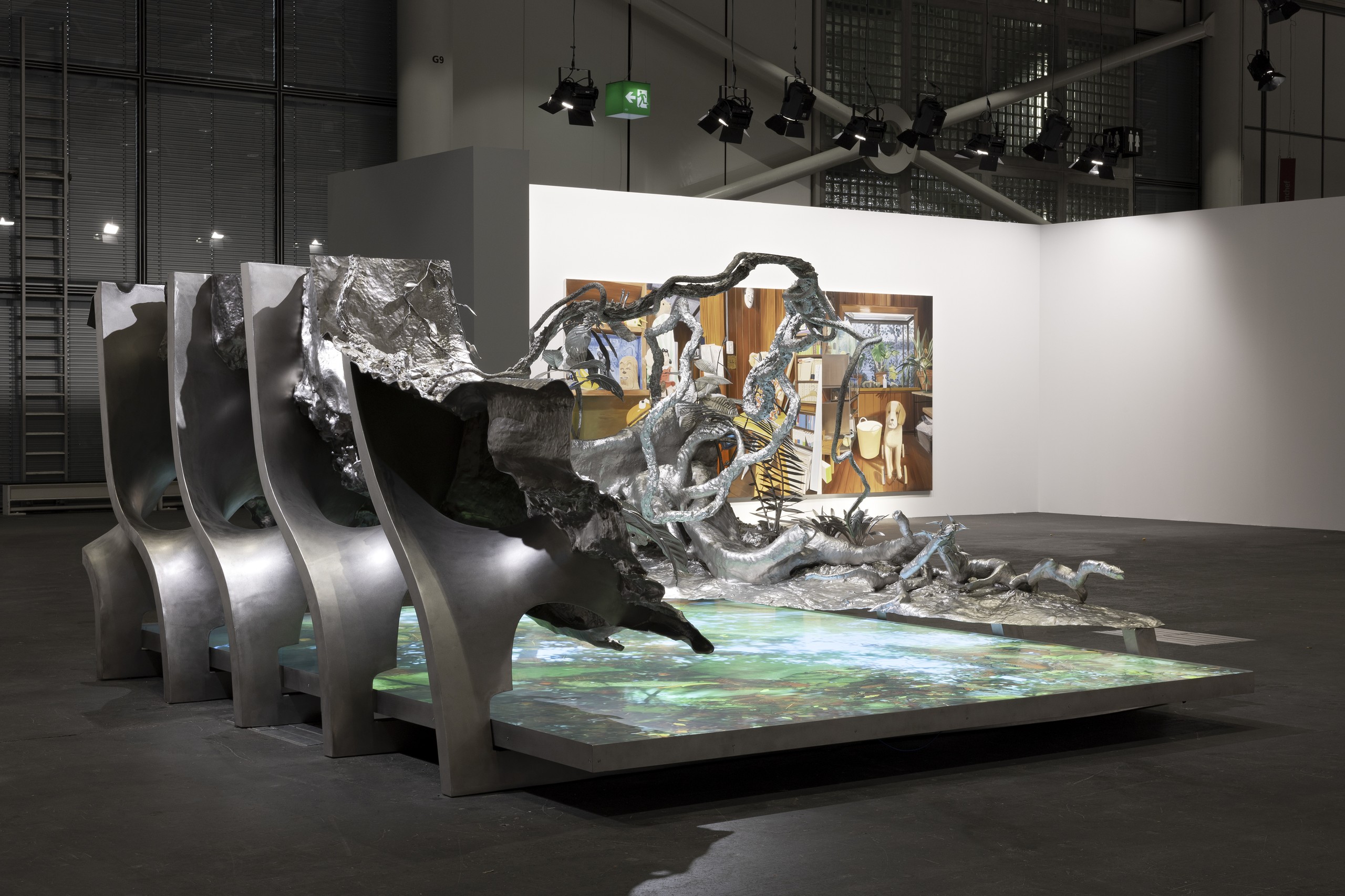
For Art Basel Unlimited 2026, Timur Si-Qin presents his sculptural installation Mariposita. A German-born artist of Mongolian-Chinese descent, Si-Qin works across sculpture, moving image, and installation to imagine new spiritual protocols for relating to the living world in the face of climate change and biodiversity collapse. Mariposita inaugurates a new body of works engaging with the Peruvian Amazon, which will be exhibited at Société in November 2026. The work takes its title from the Spanish word for “little butterfly,” and from the blue morpho butterflies, among other species, that Si-Qin encountered during periods of isolation deep in the Ucayali region of the Peruvian Amazon. Based on 3D scans made by the artist of a Renaco tree and its surrounding pond ecosystem, the installation translates buttress roots, insects, water, plant matter, and reflected light into stainless steel and moving image at the 1:1 scale of the real tree—spanning 4.4 by 4.2 meters across the floor and rising to 2.2 meters in height, a pristine fragment of a living tree and its ecosystem, reproduced at full scale. Through its combination of sculptural and moving-image elements, the work creates a space of heightened attention in which technological reproduction becomes a devotional act: a form of mirroring, naming, and reminding viewers that such environments still exist, even as their existence is increasingly threatened.
Unlike traditional casting methods, which would require harvesting and killing the tree, Si-Qin’s 3D scanning process documents the Renaco and its ecosystem without physical harm. The scans are then 3D printed in segments in castable resin before being welded, finished, sandblasted, and polished, resulting in a translation that is at once technologically precise and ethically grounded. Despite using cutting-edge technologies to create his works, Si-Qin’s focus is on nature itself. “I’ve always felt that my work has been misinterpreted as being about technology. It has always been about nature,” Si-Qin has said. “I don’t see technology as a separate ontological category. Since we’ve made cave paintings we‘ve been using technology to make art. It’s simply what’s available.”




Si-Qin’s engagement with trees as subjects of devotional attention has been central to his practice for several years—rooted in the conviction that the displacement of nature from the center of Western spiritual life is inseparable from the environmental crisis we now face. His monumental commission Sacred Footprint (2024), permanently installed in the atrium of Meta’s New York headquarters, synthesized 3D scans of multiple tree species from the Catskills and Adirondacks into a single 50-foot suspended form in stainless steel and aluminum. Mariposita marks a significant shift in this ongoing inquiry: where Sacred Footprint draws multiple trees to construct a universal symbol, Mariposita is rooted in a single, specific encounter: one tree, one pond, one ecosystem, which the artist experienced during periods of extended isolation deep in the Peruvian Amazon.
For Si-Qin, Mariposita is a meditation on the concept of the pristine. For most people in contemporary societies, truly wild places are rarely, if ever, experienced. The pristine names an encounter with living worlds so intact, vivid, interdependent, and self-generating that they can feel almost impossible from within contemporary life. As direct experiences of such ecosystems become increasingly rare, images of the pristine are often dismissed as fantastical, romantic, or merely aspirational. Yet this apparent unreality reveals how distant modern culture has become from the living systems that sustain it.
“I‘m always trying to go towards the most realistic depiction of nature because I think nature is herself the most radical,” Si-Qin explains, “For me, the process of seeing nature and trying to depict it is a meditative and devotional practice in itself.” In Mariposita, this devotional act of mirroring is both an artistic method and an ecological ethic: a gesture toward the forest spirits of the Ucayali, the fragile worlds threatened by extraction and deforestation, and the possibility of learning to walk differently within the living fabric of the earth.
This project was realized in collaboration with Magician Space and the Sigg Art Foundation.